best ai app builder platform
The best AI app builder platform is one where AI agents build the app and you own the infrastructure it lands on, not a sandbox the platform controls.
Last updated
The best AI app builder platform is one where AI agents build the app and you own the infrastructure it lands on, not a sandbox the platform controls. my-app.engineer does this: you describe the app in chat, agents design and build it, and it deploys to a Kubernetes cluster you own, including hardware you bring from home.
Which AI platform can build an app?
my-app.engineer builds real applications from a chat description. You write plain language, not a spec or a form, and a manager agent turns that into a build plan while a builder agent writes real source into a real repository. It is not snippets in a chat window and it is not a visual builder's proprietary export. It is an application that runs anywhere Docker runs.
The flow is five steps and it matters what each one is. You describe the app. A blueprint comes back as a list of capabilities you can edit before anything is built, because a wrong assumption is cheap to fix at the blueprint stage and expensive after the build. The agents plan and write. The app deploys itself to a K3s cluster as a Helm release, with a database if it needs one, and answers on a real address at <app>.<user>.my-app.engineer. Then a separate QA agent opens the deployed app in a real browser and checks it does what the blueprint said. A build that does not pass is not called done.

This is a code platform, not a no-code one. The agents write the code. You do not have to. But the output is code in a repository you control, which means a developer who comes along later is not looking at a proprietary format they cannot read.
How do you build a platform with AI?
Building a platform is harder than building an app, and the difference is reach. A platform needs persistence, payments, auth, and the ability to keep running while pieces of it change. my-app.engineer handles this through build types chosen before the first line is written, because the type decides persistence, payments and how hard QA is.
A demo build has no payments and memory only, with one QA pass, done when deployed. A delivery build has a real database, payments wired to the client's own account, and QA up to four iterations. A product build has a real database, payments provisioned automatically, and QA up to five iterations. A demo that later needs to take money is not upgraded in place. It is rebuilt as the type it should have been, because payments and persistence reach into every part of the app.
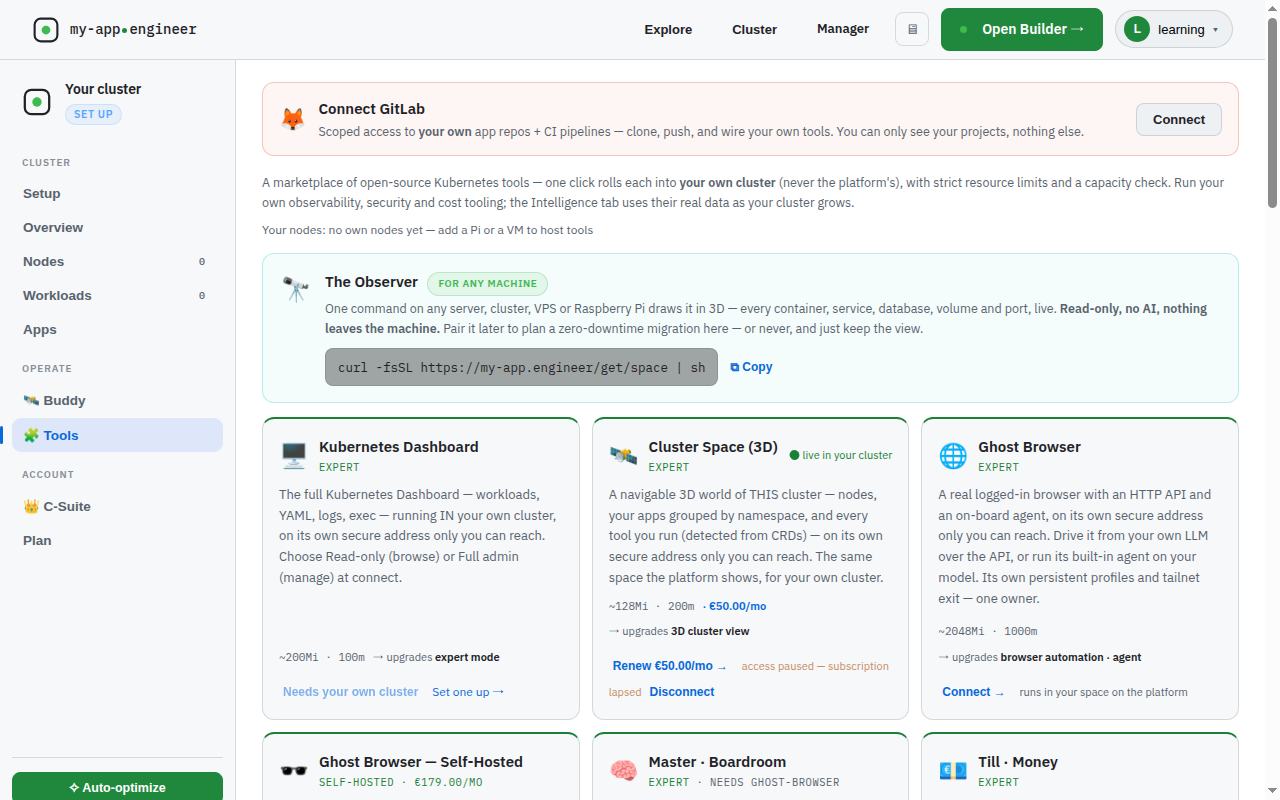
For the parts a platform needs beyond the app itself, the cluster has a catalogue of one-click tools that install into the same cluster and are reachable from the account without a second login. Ghost Browser is a real Chromium the agents drive, used for anything that needs a logged-in session. MinIO is object storage. Velero handles backups. Falco does runtime security monitoring. These are real tools with real names, not rebrands.
Where does the app actually run?
The app runs on K3s, in a namespace that belongs to your account, deployed as a Helm release. You can join your own hardware to the cluster over a private network and pods schedule onto it like any other node. That is the bring-your-own-node path, and it is what makes the running cost of an app approach zero. Nothing about the runtime is invented here. Kubernetes, Helm, Postgres, Docker. Somebody who knows those knows this.
A deploy works by pushing to the repository. The pipeline compares paths against the previous commit to work out which services changed, rebuilds only those images, and rolls them out with helm upgrade --atomic, which is a zero-downtime rolling update on K3s. A release that fails its health checks rolls back rather than half-landing. The source is a real repository, not a sandbox, and leaving means taking the repository and the Helm chart with you, not starting again.
This is the honest boundary. If you want a landing page and never want to see infrastructure again, a hosted builder is a better fit and this will feel like more machinery than the job needs. If you want to own the cluster the app lives on, this is the difference that matters.
What has actually gone wrong here?
A major Postgres bump crash-looped a database. An image tag moved from Postgres 15 to 16, and Postgres does not upgrade its data directory across a major version on start, so the container came up, refused the existing data, and restarted forever. The database is now pinned to its major version, and a major upgrade is a deliberate migration, never a tag change.
Storage replicas starved etcd on a single-node cluster. Longhorn was configured with multiple replicas on one node, and the replication traffic and disk contention starved etcd until the control plane crash-looped and the cluster stopped responding. The fix is a rule: on a single node, one replica. Redundancy across replicas of the same disk is not redundancy, it is load.
These are worth more than general advice about reliability because they are the parts nobody else can write. The platform now has rules that prevent both, and the rules exist because the incidents did.
my-app.engineer is the platform described above: you describe an app in chat, AI agents build and deploy it, and it lands in a Kubernetes cluster you own, with a catalogue of cluster tools on top. If your question is whether an AI platform can build a real app and leave you owning the running thing, that is what this one does.